
PRO NOBIS CONCERT REVIEW
Music from the Spanish Golden Age – JUNE 2023
Splendid, all-enveloping richness of sound was the overwhelming impression from the very start of this fine selection of music from what the programme notes called the ‘astonishing’ number of composers writing for the church in Spain and the Spanish New World during the late 16th and early 17th centuries.
Clive Walkley has long made a special study of this music and its context in Spain, and is the author of a book on the composer Juan Esquivel, so this concert – in some ways a ‘remake’ of one Pro Nobis presented in 2012 – was one where conductor and choir were very much at home.
In a Spanish cathedral, the choir stalls are usually within a monumental enclosed structure called the Coro. There is usually a pair of organs with horizontal trumpet pipes, and a music desk at the centre where the wind players employed by the cathedral
could play. For people in the nave outside, the sound would fill the vast echoing space and seem like a mystical aural image of heaven – as it was no doubt intended to.
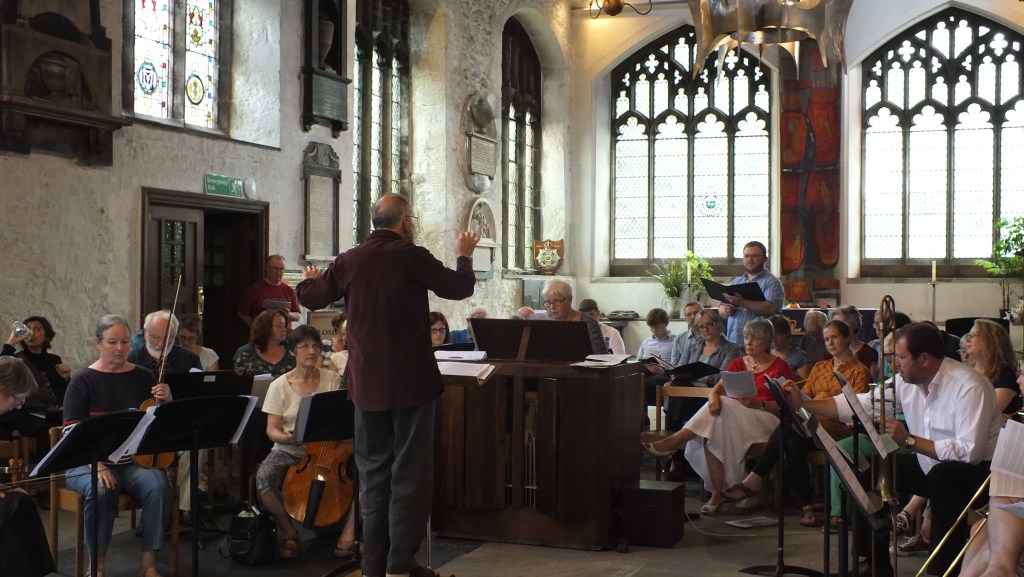
In the smaller, plain, and quite barn- like interior of St George’ s Church Kendal, the effect was like sitting within the Coro itself – at least for those of us near the front.
The Pro Nobis singers, sometimes split into two or even three choirs, were joined by the English Cornett and Sackbut Ensemble, led with virtuosic flair by Gawain Glenton, who often added improvised embellishments to the top line as they doubled the choir voices. Cornett players were sometimes criticised by the cathedral authorities for doing too much of this – which proves that Gawain was being thoroughly authentic, though his ornamentation was discreet and elegant enough to enhance rather than distract from the voices.
Ian Pattinson played Gawain’s beautiful wooden- pipe chamber organ, imported for the occasion, and the full forces singing and playing together, as in the impressive twelve- part ‘Duo Seraphim’ by Francisco Guerrero, were magnificent and truly spine- tingling in places, with the powerful soprano sound soaring high over all.
The acoustic of St George’s was very suited to this music and definitely enhanced its effect, though it did cause some loss of clarity at times. In some of the large-scale pieces the instruments did not double the voices throughout, but came in at particular points to reinforce important phrases, which was very effective, though it was then almost impossible to hear the words, even when these were from the familiar text of the Mass. However this is not to criticise the diction of the choir, and in intimately scored pieces sung unaccompanied the detail came across much better.
In the beautiful ‘Hortus Conclusus’ by Rodrigo de Ceballos they were especially sensitive and expressive, with some lovely dynamic variation, and the final quiet unison was perfectly tuned and delicate, the sopranos in particular sounding as one voice. Throughout the programme, the qualities of Pro Nobis which stood out above all were precision in the counterpoint, especially good in Juan Gutierrez de Padilla’s ‘Missa Ego Flos Campi’ where there was rapid alternation of off-beat entries across the choirs, and in the more reflective pieces the exact blending of the voices within each part, and the almost perfect tuning. This was particularly impressive in the short unaccompanied ‘O bone Jesu’ by Pero de Gamboa, and in ‘Super flumina Babylonis by Sebastian Lopez de Velasco, where the harmonic movement, more complex than in some of the bigger pieces, was very skilfully managed.
There were several items in the programme for instruments only, including two pieces played between movements of the Padilla Mass, as the Spanish wind players would have done within the liturgy. In one of these, ‘Magna et mirabilia’ by Thomas Crecquillon, Gawain Glenton played almost continuous divisions on the top line, very reminiscent of published examples from the time, but his own creation – and different every time he plays the piece. Later, the beautiful and expressive six-part ‘Versa est in luctum’ by Sebastian de Vivanco had more discreet ornamentation and some lovely smooth and delicately blended playing from all the instruments.
Each half of the programme finished with hymn settings by Esquivel. As a change from the polyphony, these had unison passages which were either plainsong or more folk-like tunes, and one could imagine these tunes sung by a larger congregation. The evening hymn ‘Te lucis ante terminum’ was quiet and sensitively sung, and then a short organ prelude led into the final piece of the concert, Pange Lingua, popular in Corpus Christi processions. The unison passages were thrillingly performed exactly as one voice by the entire choir, and the instruments joined in alternate verses with two recorders and mute cornett providing a variety of tone colour – leading to a triumphant final chord with a spectacularly resonating bottom note from the bass sackbut.
PHILIP GRUAR
PRO NOBIS CONCERT JULY 2022
Music for a Summer Evening
Pro Nobis singers came up with the perfect recipe for a warm summer evening, a light-hearted and accessible programme to end the year. Temporarily forsaking their usual Baroque fare, the Natland-based ensemble dedicated an entire programme to the 150th anniversary of the birth of Ralph Vaughan Williams along with a tribute to Her Majesty the Queen.
Director Clive Walkley has consistently showcased quality contemporary music along with long-established composers, and while Vaughan Williams’ songs and arrangements dominated the programme, there was room for works by Cecilia McDowall, harpist Gill Lowden and local composer Adrian Self.
Highlights of the evening were The Lover’s Ghost, one of Vaughan Williams’ many arrangements of English folk songs, and The Cloud-Capp’d Towers, one of three songs he set to Shakespeare’s verses, bringing out all the versatility and delicacy we have come to expect from Pro Nobis.
Another memorable moment was soprano Jane Maycock’s astonishingly pure solo in Stanford’s Blue Bird, the sound melting away exquisitely into the rafters of St Mark’s Church at Natland.
Adrian Self’s organ suite, written to celebrate the Queen’s 90th birthday in 2016 and performed by Walkley, brought variety to the programme, along with an elegant harp duet by Lowden and AnnaKate Pearson.
Pearson then joined the singers for McDowall’s irreverent “Fancy of Folksongs”. You would have thought that there wasn’t much more to be done with the old favourite Oh No John, but McDowall manages it, bringing the evening to a somewhat raucous conclusion.
Pro Nobis, founded by Walkley 53 years ago, maintained their usual high quality of performance throughout and the sound was well balanced. If there is a small quibble it would be that the choir was standing too far away, up close to the altar. A small ensemble singing a capella needs to relate more intimately with its audience, who want to see as well as hear the performers; hopefully in future they will stand closer.
Rosie Wates
PRO NOBIS CONCERT SUNDAY 6TH FEBRUARY 2022
The Pro Nobis Choir assembled at Holy Trinity & S. George Roman Catholic Church in Kendal to present its delayed Christmas concert. This building has a superb acoustic for choral music, and the choir were in fine form. Like many other local choir conductors, Clive Walkley always produces an interesting, varied and challenging programme.
The concert opened with Herbert Howells fine setting of the Magnificat and Nunc Dimittiswhich he dedicated to S. Paul’s Cathedral. This is Howells at his superb best. The organist Andy Plowman got the best out of the electronic instrument which is sadly a replacement for the original pipe organ. This is typical Howells which builds and builds to a climax, and it was a privilege to hear this music again.
A short, but exquisite motet by Schutz featured the two soloists. It was good to listen to the alto line sung by Michael Deakin, an authentic counter-tenor. Although not a dying art, many cathedrals, including some of the major ones, are having to appoint female altos to the traditional part. The soprano soloist, Faye Bowness, was a very effective partner.
Rather moving performances of Lux Aurumque (Whitacre) and O Magnum Mysterium(Lauridsen) were of particular note, whilst other modern compositions were well represented by Macmillan, Malcolm Archer and Owain Park, plus Clive Walkley’s own compositions. He writes very effectively for his choir, and Pro Nobis concerts regular include compositions by local composers, Adrian Self of Cartmel Priory being another extremely effective composer.
The Magnificat in D by the relatively obscure Bohemian composer Zelenka brought the concert to a fitting conclusion. Once more, Andy Plowman set as perfect registrations as the instrument would allow. One of the more interesting sections in this work was the lengthy ‘Amen‘, somewhat reminiscent of Handel’s more famous conclusion to his Messiah.
However, Zelenka’s work almost certainly pre-dated the more illustrious Handel.
Intonation, chording and diction were excellent throughout.
Throughout the programme, the music was interspersed with readings delivered with feeling by Rev. David Smethurst.
Robert Talbot
To read Westmorland Gazette review of our February 2022 concert please click here
Audience feedback from our 50th Anniversary Concert in June 2019
‘The performance of Purcell’s ‘Come Ye Sons of Art’ was outstanding’
‘The Valls was stupendous’
‘Brilliant! Beautiful voices’
‘Amazing evening!’
‘Pro Nobis are like a fine wine – vintage, fresh and full-bodied!’
‘Truly a special occasion: musicology and fine performance going hand in hand’
‘South Lakes is very fortunate to have this very special choir and the
opportunity to hear such excellent music’
South Lakes poets and artists team up for Pro Nobis – October 2019
The wealth of cultural talent in South Lakes was perfectly illustrated by Pro Nobis on October 12 with a concert showcasing contrasting works by two composers and two poets from the district. The Natland-based choir was in fine voice for premieres of major pieces by its conductor Clive Walkley and Cartmel Priory organist Adrian Self, with words by Kendal therapist Lucy Crispin and Pam Self respectively. A fine and fitting contribution to Pro Nobis’ programme of concerts during this celebratory year marking its 50th anniversary. Opportunities to hear accessible modern and contemporary choral music performed expertly are to be treasured and Pro Nobis has rarely disappointed during its 50 years existence.
Walkley and Crispin, one of the choir’s leading sopranos, produced their dramatic cantata, The Song of the Silent Child, over two years. An allegorical fable with elements of fairy-tale and folk-lore, it is very much in tune with our times; ill-defined threats from the weather sow panic and uncertainty and while the writing pre-dates the appearance of Greta Thunberg, it is hard not to see a parallel.
Walkley has gone for drama rather than musical complexity, with simple repeated rhythms and much unison or two-part singing from the choir. His finest writing came in the lyrical solo sections where tenor Robert Thompson and the Carlisle-based bass Jonathan Millican told the story with theatrical verve. Crispin and Jane Maycock sang the challenging parts of Old Mother Love and the Child.
Self, a frequent collaborator with Pro Nobis, has established a fine reputation for his religious choral music and his setting of his wife’s four poems collected as Called Back to Paradise can hold its own alongside his best-known works. The choral writing is complex and puts the choir through its paces, with frequent time, key and chromatic shifts. Yet it is at the same time accessible and truly matches the deep religious and nature-loving tone of the poetry.
The four pieces contrast beautifully; the upbeat Called Back to Paradise Again proclaims religious principles; in the contemplative Candles, flickering firelight recalls Cartmel monks put to death at the time of the Reformation; Catkins is a jaunty paean to spring; finally Thanksgiving brings the other three themes together, marrying religion and nature in a finale in turn anthemic and playful.
The programme was punctuated with shorter works by Finzi, Kodaly and the Latvian composer Peteris Vasks. Despite the depredations of a cold virus on the soprano section, Pro Nobis was as rewarding as ever.
Rosie Wates
Pro Nobis 50th Anniversary Concert review – June 2019- by Philip Burton
What an evening of celebrations and anniversaries! Purcell’s music to celebrate the birthday of Queen Mary in 1694 (Come Ye Sons of Arts), Striggio’s 40 part motet Ecce beatam lucem that may have been performed in 1565 to celebrate a marriage between two dynastic families in Florence and the opulent polychoral Missa Scala Aretina by Francisco Valls that simply exudes joy.
Above all, however, it was an evening to celebrate the 50th anniversary of Pro Nobis under their conductor, Clive Walkley. It was a night to remember with distinguished soloists- Evelyn Tubb, Iestyn Morris, Jonathan Millican, Samuel Jenkins and Tamsin Jones- excellent instrumental playing from the Pro Nobis Baroque Players, the Pro Nobis Singers, (with a little help from the Rushley Singers) but above all to acknowledge the inspired leadership of their conductor, Clive Walkley.
The highlight was a stunning performance of the Mass Scala Aretina something that Pro Nobis and Players revelled in. Did Clive imagine 50 years ago, he would be conducting such as ambitious work? Some wonderful ensemble work between the four choirs, for example, in the Sanctus, and many memorable moments of dramatic expression to capture the words such as in the Qui Tollis or in Et Incarantus.
A well balanced performance of Come Ye Sons of Arts with beautiful phrasing from the choir and the Players. I did feel, however, that occasionally the performance lacked the musical sparkle of a birthday celebration.
As a member of the choir performing Striggio’s 40 part motet, Ecce Beatam Lucem the experience of standing within a glorious expansive canvas of sound from the 10 choirs must be something to remember. The biggest logistic challenge of performing this piece at Kendal Parish Church was the staging. To accommodate an expanded choir, the location of the singers meant that the audience were not really able to fully experience that canvas of sound as the sound was caught up in the area they were performing. When the choir came forward for the Mass and Come Ye Sons- the sound was rich and balanced. But the contrasts between smaller ensemble work and the full body of sound had telling effect.
But the accolades at the end of the evening bestowed on the choir and Clive were fully deserved for one of the most accomplished choirs in South Lakes. Long may Pro Nobis continue after celebrating a triumphant 50th anniversary concert.
 The Pro Nobis Singers